
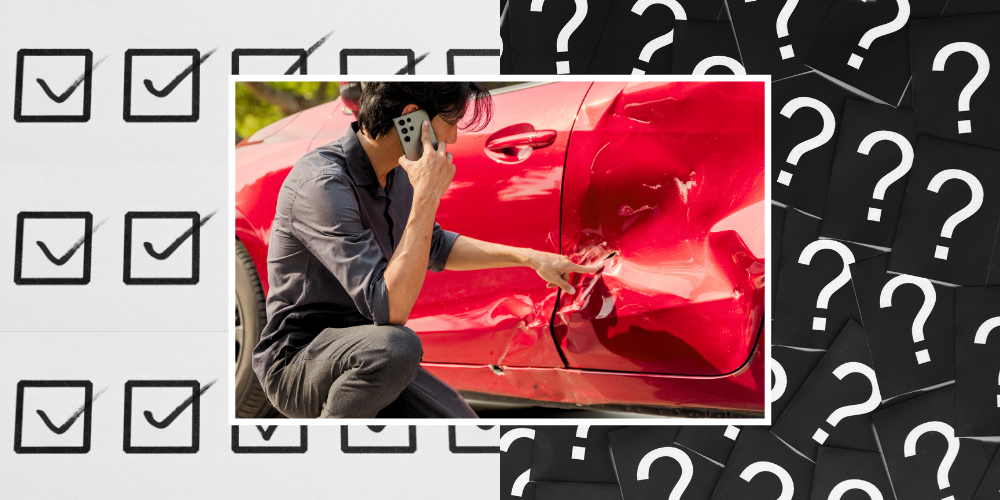
After a serious accident, you are likely wondering whether or not you might have a strong legal case, and additionally, whether or not you can recover compensation for the damages you’ve suffered.
There are many factors involved in determining if a lawsuit after a vehicle accident is possible and winnable. Motor vehicle accident (MVA) cases aren’t built on a single fact, but on a combination of factors. If one part is weak, the entire case can lose value. To understand these factors, let’s look at two fictional (but very common) MVA scenarios.
The Clean Liability Case
It was late afternoon at a busy intersection. Traffic was moving normally. Our client was driving straight through during a green light when a delivery truck barreled through the red light and crashed into the driver side door of their vehicle. The crash was severe.
Police arrived quickly and multiple witnesses confirmed what happened. The officer issued a citation to the truck driver for running the red light, and the report clearly assigned fault. Luckily, the at-fault driver was well-insured, with bodily injury liability coverage exceeding minimum policy limits.
An ambulance took our client from the scene. At the hospital, imaging confirmed two fractures in their left leg which required surgery. Soon after the accident, our client’s spouse recognized the significant costs that would be involved and called our office from the hospital.
The Gray Zone Case
Two vehicles were traveling side-by-side on a multi-lane road. It was unclear what happened next: one of the cars drifted, or maybe changed lanes, and the other reacted too late. The result was a sideswipe accident where our client hit the curb and a large sign.
Both drivers insisted the other caused the crash. There were no independent witnesses or traffic camera footage. The police report reflected conflicting statements and didn’t assign clear fault. Both drivers carried only the minimum insurance required in Florida.
After the crash, our client reported feeling a little sore, but not seriously injured. However, after a few days, they developed neck pain. After two more weeks, they realized the pain was getting worse. It was approaching four weeks after the accident when they finally saw a doctor and then began physical therapy. Due to the cost of therapy, they quit after only a few sessions. Over two years after the accident, they realized that the injury was worse than they thought, and they called Schlesinger Law Offices.
What Makes a Strong Car Accident Case?
Keeping these two scenarios in mind, let’s walk through five key points that make up a successful case:
- Liability: Who caused the crash?
- Coverage: Is insurance coverage present?
- Damages: How serious are the injuries and losses?
- Documentation: Can you prove what happened?
- Timing: Did everything happen within legal deadlines?
Liability
Proving fault as clearly and as early as possible is one of the most important factors in building a strong case. The more clearly you can show who caused the accident, the harder it becomes for insurance companies to dispute responsibility.
Accidents with clear, obvious liability include:
- Rear-end collisions
- Collisions caused by one party running a red light/stop sign
- Collisions resulting from distracted or impaired driving
On the other hand, it can be much harder to build a strong case when:
- There is shared fault
- There are no witnesses
- No police report was filed
- Conflicting stories are present
When liability is unclear, insurance companies have room to argue, which can lead to lower settlement offers, denied claims, and no basis for a lawsuit.
➤ In the Clean Liability Case, fault was clear from the start. Witnesses and the police report confirmed exactly what happened, leaving little room for dispute.
➤ In the Gray Zone Case, conflicting accounts and a lack of independent evidence made it difficult to prove who caused the crash, weakening the case immediately.
Coverage
No matter how serious the accident or the injuries, a case is only as valuable as the available insurance coverage. To recover meaningful compensation, there must be insurance or other financial resources available to cover damages.
Key Types of Coverage:
- Bodily Injury (BI):
Pays for injuries caused by the at-fault driver - Uninsured/Underinsured Motorist (UM/UIM):
Your own coverage; used when the at-fault driver has little or no BI - Personal Injury Protection (PIP):
Covers a portion of medical bills and lost wages regardless of fault (typically limited to $10,000)
The strongest cases involve at-fault drivers with substantial bodily injury (BI) coverage, whether through a personal policy or an employer. However, cases become more complicated when coverage is limited. Florida does not require drivers to carry bodily injury coverage. As a result, many damage claims are effectively limited to PIP coverage, which is typically just $10,000.
When little or no coverage exists, recovery may be significantly limited, regardless of how serious the accident or injuries may be.
➤ In the Clean Liability Case, the at-fault driver carried substantial bodily injury coverage, meaning there were insurance funds available to compensate our client’s injuries.
➤ In the Gray Zone Case, both drivers had only minimal coverage, which significantly limited the potential recovery regardless of how the case was decided.
Damages
Damages determine what a case is worth. Damages can include not just medical bills, but also the seriousness of the injuries and how they will impact your life moving forward.
You strengthen your case when:
- You seek consistent medical treatment, showing the severity of your injuries
- There are objective findings that support your condition (MRIs, surgeries, specialist reports)
- Symptoms appear soon after the crash (although some serious injuries can take time to develop)
What can weaken damages?
- Gaps in treatment (even for legitimate reasons, such as cost)
- Delayed complaints
- Minimal or no care
These issues can allow an insurance provider to raise questions about how serious the injuries are and can reduce the value of a case.
➤ In the Clean Liability Case, the client received immediate and consistent medical care, and imaging confirmed serious injuries that required surgery.
➤ In the Gray Zone Case, delayed treatment and gaps in care made it harder to show the full extent of the injuries, which weakened the case.
Documentation
Documentation supports every claim you make. It can overlap with other factors like liability and damages, in that it makes those factors concrete and able to be used as evidence.
For example, it’s not enough that there were witnesses to the crash; their statements must be documented. Additionally, it’s not enough that an injury exists; you need the imaging, reports, and records that show it.
Strong and organized documentation means that every part of the case is supported by clear, consistent evidence. When the records align, from the accident report to medical treatment, it strengthens credibility. When documentation is missing or inconsistent, even valid claims can lose value.
➤ In the Clean Liability Case, the witnesses provided statements, the police report documented the crash, and the medical records confirmed the injuries. The claim that there were damages was clearly supported by evidence.
➤ In the Gray Zone Case, the lack of witness statements and gaps in medical documentation made it harder to prove both how the accident happened and how the injuries developed.
Timing
You can have a strong case and still lose significant value (or even the entire case) solely because of timing.
How can this happen?
- Evidence can disappear
- Witnesses may forget important details
- Insurance companies can gain leverage
- Legal deadlines will expire
In Florida, timing can especially critical. To access full PIP benefits, you must seek medical treatment within 14 days of the accident. Waiting too long can limit the benefits available even if you were genuinely injured.
Beyond that, Florida law generally gives you two years from the date of the accident to file a lawsuit. Even so, waiting until the deadline approaches can still weaken your case. Last-minute claims leave little time to investigate, gather records, consult experts, and properly prepare for litigation.
For timing to work in your favor, it’s essential to act early. Seeking medical attention, documenting what happened, and speaking with an attorney as soon as possible can give your case the best chance of success.
➤ In the Clean Liability Case, both medical care and legal support are sought soon after the accident, ensuring that no deadlines were missed.
➤ In the Gray Zone Case, delays in treatment meant the 14-day window was missed, and waiting years to seek legal help put the claim at risk of missing the statute of limitations, potentially making it impossible to file a lawsuit at all.
Key Takeaways
- Strong cases are built on liability, coverage, damages, documentation, and timing
- Insurance coverage often determines the ceiling of recovery
- Immediate and consistent medical care strengthens claims
- Documentation must be clear and consistent
- Early action can dramatically impact case value
- An experienced attorney who can guide you through the process increases your chances of a good outcome
Hire the Most Experienced Motor Vehicle Accident Law Firm
With more than 70 years of experience, Schlesinger Law Offices has handled a wide range of motor vehicle accident cases and understands what it takes to build a solid case from the start. Our attorneys understand how liability, coverage, damages, documentation, and timing work together and know where cases can be strengthened or lost.
Have questions? Contact our office today.
Please note: we operate on a contingency basis, meaning that you pay nothing unless we recover compensation for you. This way you can focus on recovery, not legal fees.
Want more content like this? Sign up for our newsletter to get articles and updates delivered straight to your inbox.